Differences and similarities between propiconazole and cyproconazole
Core Commonalities
Despite being distinct compounds, both fungicides share the same primary biochemical target: they inhibit C14α-demethylase, a key enzyme in ergosterol biosynthesis. This disruption compromises fungal cell membrane integrity, ultimately suppressing mycelial growth and spore germination.
2. Systemic Properties
They are highly systemic and exhibit ambimobile translocation within the plant. Following application via foliar spray or root uptake, these compounds are readily absorbed and can move bidirectionally (both acropetally and basipetally) through the xylem and phloem.
3. Target Disease Spectrum
Their efficacy is primarily against fungal pathogens within the Ascomycota and Basidiomycota phyla, including diseases like powdery mildew, rusts, *Rhizoctonia* sheath blight, and apple scab. Notably, they are ineffective against Oomycete pathogens such as those causing downy mildews.
4. Plant Growth Regulation Effect
A secondary physiological effect of both is the mild inhibition of gibberellin biosynthesis in plants. At elevated application rates, this can manifest temporarily as reduced internode elongation or stunting.
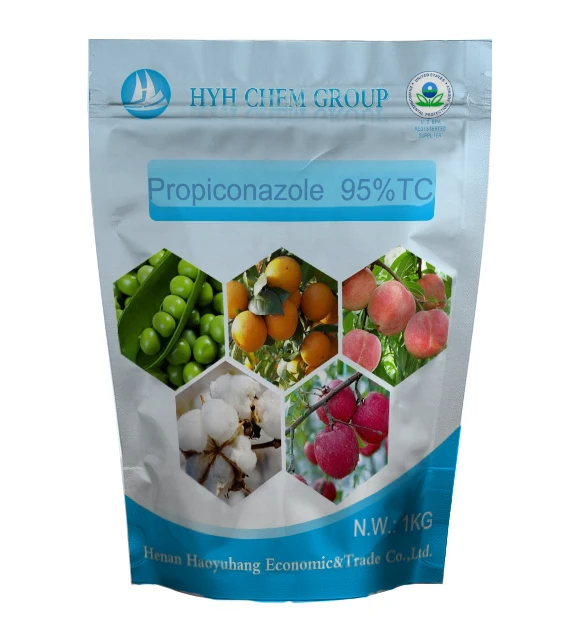
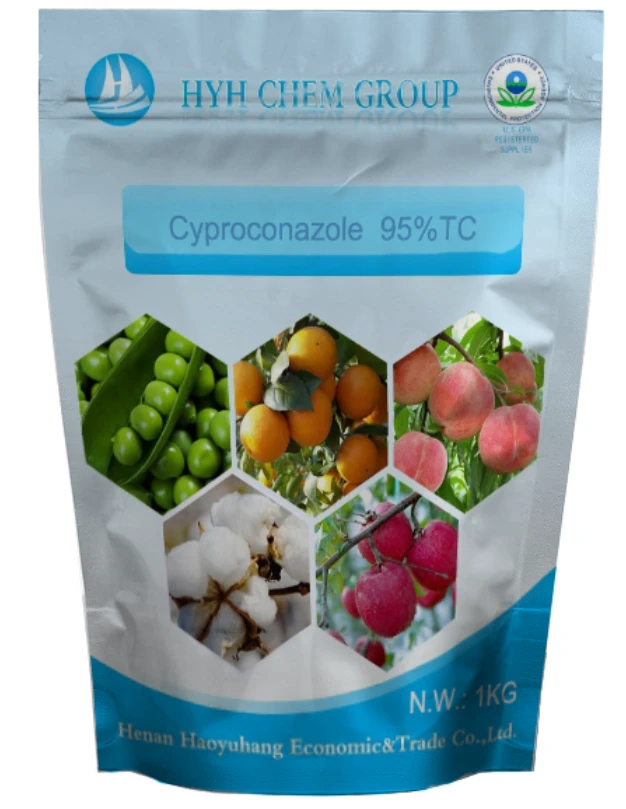
Key differences (table comparison)
|
Comparison Dimensions
|
Propiconazole
|
Cyproconazole
|
|
Chemical Structure
|
Chemical Name: 1-[2-(2,4-Dichlorophenyl)-4-propyl-1,3-dioxolan-2-ylmethyl]-1H-1,2,4-triazole
Structural Feature: Contains a dioxolane heterocyclic ring structure. |
Chemical Name: 1-(4-Chlorophenyl)-4,4-dimethyl-3-(1H-1,2,4-triazol-1-ylmethyl)pentan-3-ol
Structural Feature: Features a pentanol aliphatic chain structure with no heterocycle (aside from the triazole group). |
|
CAS number
|
60207-90-1
|
94361-06-5
|
|
Spectrum of Control Emphasis
|
Demonstrates stronger activity against diseases caused by Basidiomycota fungi, such as rice sheath blight, wheat sharp eyespot, banana leaf spot, and peanut leaf spot. It also provides a certain degree of efficacy against Ascomycota diseases like powdery mildew and apple scab.
|
Shows superior efficacy against diseases caused by Ascomycota fungi, including wheat powdery mildew, apple scab, pear scab, and bean rust. Its effectiveness against Basidiomycotadiseases is generally slightly weaker compared to propiconazole.
|
|
Suitable Crops
|
Has a broad spectrum of application and is primarily used on cereal crops (such as rice, wheat, corn), bananas, peanuts, and vegetables.
|
Its use is more focused on cereal crops (wheat, barley), fruit trees (e.g., apple, pear), legumes, and sugar beets.
|
|
Phytotoxicity Risk
|
It exhibits a relatively stronger plant growth-inhibiting effect. Application during sensitive growth stages such as the seedling, flowering, or young fruit stages may lead to plant stunting, leaf curling, or fruit malformation. Therefore, strict concentration control is essential.
|
It has a milder plant growth-inhibiting effect and carries a lower risk of phytotoxicity. Consequently, it can be used during sensitive crop development periods, such as the stem elongation stage in wheat or the young fruit stage in fruit trees.
|
|
Physicochemical Properties
|
It has a relatively higher vapor pressure (0.13 mPa at 20°C) and stronger volatility, contributing to good field redistribution capability. This makes it well-suited for spray applications targeting canopy diseases.
|
It exhibits slightly higher water solubility (100 mg/L at 20°C), facilitating faster systemic uptake and translocation within the plant. This property makes it particularly suitable for application methods like seed treatment or soil drenching to manage soil-borne or seed-borne diseases.
|
|
Common Dosage forms
|
Emulsifiable Concentrate (EC), Suspension Concentrate (SC), and Emulsion Oil in Water (EW), primarily used for spray applications.
|
Water-dispersible Wranule (WG), Wlowable concentrate for Weed treatment (FS), and Suspension Concentrate (SC), suitable for both spraying and seed treatment.
|
|
Residue and Pre-harvest Interval
|
It has a moderate residual period. The recommended pre-harvest interval (PHI) for grain crops is typically 7–14 days.
|
It has a relatively shorter residual period. The recommended PHI is approximately 5–7 days for grain crops and 10–15 days for fruit trees.
|
Application Recommendations
1. For controlling rice sheath blight or banana leaf spot, propiconazole is preferentially recommended due to its superior efficacy against these diseases.
2. For controlling wheat powdery mildew or apple scab, cyproconazole is the preferred choice, offering higher application safety.
3. During sensitive crop stages such as seedling or flowering, the use of propiconazole should be avoided; cyproconazole can be considered as an alternative.
4. Both agents carry a significant risk of fostering fungal resistance. It is advised to rotate or tank-mix them with fungicides having different modes of action, such as azoxystrobin or mancozeb.
5. When a stronger curative effect is needed for existing infections, cyproconazole is typically the better option due to its enhanced therapeutic and eradicant properties.
6. For broad-spectrum preventive protection or when managing a wider variety of crops and diseases (e.g., banana leaf spot, rice sheath blight), propiconazole offers wider applicability.