

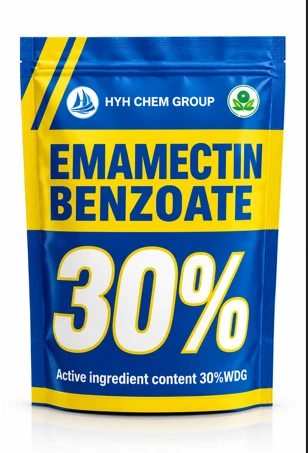
Emamectin Benzoate 30% WG - Technical Brief
Emamectin benzoate is a semisynthetic avermectin, made by putting a methylamino group on the B1 molecule. That one substitution does a lot: it lifts activity against Lepidoptera above abamectin's and it makes the molecule cross leaf cuticle rather than sit on top of it. IRAC group 6. No cross-resistance with pyrethroids, organophosphates, diamides or growth regulators.
The 30% WG is the high-load solid grade. One kilogram carries 300 g of active, which at ordinary field rates covers somewhere between twenty-five and thirty-five hectares.
What it does to an insect
It holds glutamate-gated chloride channels open. Chloride floods the cell, the membrane hyperpolarises, and the insect can't fire a nerve signal any more. Feeding stops within a few hours. Coordinated movement fails. Death takes two to four days.
That last number causes trouble. Growers who check the field on day two see live larvae and conclude the spray failed, when in fact the larvae stopped eating on day one and the damage already done is the damage they're looking at.
The leaf is the part people underestimate. Emamectin passes through the cuticle and distributes in the tissue. A leafminer inside its gallery, a larva in the growing point, a borer under the epidermis: none of them has to be hit by a droplet. They eat treated leaf and pick up the dose that way. This is why the product is specified against leafminers, leaf rollers and borers rather than against insects that sit in the open where you can see them.
Why the granule rather than the EC
Solvent is the first reason. A 5% emulsifiable concentrate is sixty to seventy percent solvent and emulsifier by weight. Put that on summer leafy vegetables, tea, or young fruit at thirty-five degrees and it softens cuticle wax, strips the bloom off grapes, marks petals, scorches margins. Symptoms turn up two or three days later, which is long enough for the spray to escape blame and for downy mildew to take it.
Freight is the second. Ten grams of active per hectare out of a 5% EC is 200 mL of product. Out of the 30% granule it's 33 g. Same hectare, six times the mass in drums, plus six times the empty containers going back.
Third, a dry granule doesn't separate. No cream layer, no sediment that won't shake back into suspension, no solvent weeping at the seam after a summer in an unairconditioned store.
Then there's the small thing that actually causes most of the mistakes. Two grams per mu is a dose people get wrong, and a one-gram error is a fifty percent error. Granules weigh clean and stay weighed. Liquids cling to the measure, and the last fifth of the bottle becomes guesswork.
Dose
Rates below are for the 30% granule. They're the usual field range. Your registration is the legal number and it wins every argument.
| Situation | Active, g/ha | 30% WG, g/ha | 30% WG, g/mu | Per 15 L tank (~0.5 mu) |
|---|---|---|---|---|
| Young larvae, light pressure | 8–10 | 27–33 | 1.8–2.2 | 0.9–1.1 |
| Mixed instars, heavy pressure | 12–15 | 40–50 | 2.7–3.3 | 1.3–1.6 |
Water volume matters more than most people allow for. On vegetables and other low crops, 450–600 L/ha, which is 30–40 L per mu. This is a leaf-deposit product. Cutting water to save trips saves nothing and costs control.
Timing matters more than the rate. There's no useful ovicidal action here, so the window is egg hatch to second instar. Spray at fourth instar and you'll get half the control at twice the rate, which is how resistance gets selected.
Water chemistry is worth a glance. Above pH 8 the molecule hydrolyses faster. Buffer it, or at least mix and spray the tank out the same day rather than leaving it standing overnight.
Rain: four to six hours of drying time. Wet inside two hours is a wasted pass.
Where it goes
Cabbage, cauliflower and leafy greens for diamondback moth, beet armyworm and cabbage white. Rice for leaf roller and stem borer. Cotton, chilli and tomato for bollworm, on young larvae. Citrus and pome fruit for leafminer and tortrix. Cowpea and soybean for pod borer. Tea for looper and tussock moth, with a close eye on the residue interval.
It is not a mite eradicant, not an aphid or whitefly product, and not a soil insecticide. Thrips control is partial at best and shouldn't be sold as a claim.
Limits
Group 6 resistance in diamondback moth is well established across parts of Asia, and beet armyworm is following. Two consecutive emamectin sprays per crop cycle is the ceiling; rotate to diamides, spinosyns or Bt rather than stacking applications and hoping.
Bees, silkworms and aquatic invertebrates are all seriously affected. No spraying flowering crops while bees are working, no drift toward mulberry or water, and the label buffer zone is there for a reason.
UV breaks the molecule down on the leaf surface within hours. The residual that counts is the fraction that got inside the tissue before the sun found it, which is another argument for an even, fine deposit rather than a coarse one.
Handling
Weigh it. Don't scoop it by eye. Make a stock slurry in a bucket and pour that into a half-filled tank, then top up with agitation running. Open the sachet downwind and close to the water surface, because two grams of anything is easy to inhale. Gloves and a mask, and don't leave a part-mixed tank standing overnight.S
Hot Tags: cas 55569-91-8 emamectin benzoate 30% wg, China cas 55569-91-8 emamectin benzoate 30% wg manufacturers, suppliers, factory, insecticide for bird pest control, insecticide for guinea pig pest control, insecticide for shrub pests, insecticide for soil pests, insecticide for water pests, slug insecticide


