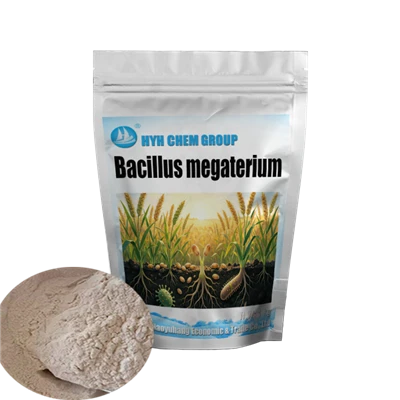
What Bacillus subtilis actually buys you
The bag holds sleeping bacteria. Nothing in it is working until it meets water, and then the spores wake up and start to grow wherever they landed. That is the whole product. Everything useful about it comes from that one fact, and so does every way it can disappoint you.
Think about what a disease does. It arrives at a root or a leaf, finds food and space, settles in, and by the time you see damage it has been living there for a week. A fungicide interrupts that at the point where you can see it. This product goes in earlier and takes the space first, so when the disease arrives there is nowhere to sit and nothing left to eat. It is less like a poison and more like moving your own people into the house before someone else does.
Once it is settled it does a few other things. It produces substances that break open fungal threads, which helps, though I would not buy it for that alone. It also switches on the plant's own defences a little ahead of time, so when a real attack comes the plant reacts faster, the way a fire drill makes people quicker on the day. And it helps roots grow, which is the part growers notice most in the field: more white roots, faster establishment after transplanting, a crop that gets away from the ground sooner.
Now the part that matters commercially. A chemical spray is a fixed amount of work. You put it on, it does what it does, and it stops. A living product can multiply. Given moisture and food, the population you put down grows, which is why a modest rate applied in the right place can outperform a heavy rate applied in the wrong one. It is the only input on the farm that increases itself.
There is also the matter of the clock. Chemicals carry a pre-harvest interval, and in the last two or three weeks before picking, most of them have nothing left to play with, which is exactly when a crop is most valuable and most vulnerable. This product has no residue problem of that kind, so it can be used in that window. For anything going to a supermarket or an export buyer, that is often worth more than the difference in knockdown speed.
And resistance. A modern fungicide works on one target, and a fungus that changes that one target escapes it, which is why products come and go on a five to ten year cycle. This organism is doing four unrelated things at once. A pathogen would have to beat all four. That is not impossible and I would not claim it is permanent, but it is a great deal harder than beating a single site, and it is the reason this kind of product tends to get better value the longer you keep it in the programme.
So how do you get those advantages? Four things decide it, and none of them is the brand.
Put it where the disease will be. On a root disease, that means the root, not the leaf. In a nursery tray before sowing, or as a dip at transplanting, is where most of the value is, because a seedling carries that root system into the field for the rest of the season.
Use enough water. A drench that wets the surface has not reached the root. You want the liquid to move ten to fifteen centimetres down, and in practice that is two to three hundred litres per hectare, rather than the fifty a knapsack makes easy.
Go in before the disease, not after. Applied to a field that is already going down, it will not pull anything back. It is insurance, not firefighting, and sold as firefighting it always disappoints.
And do not kill it on the way. Chlorinated water kills it, so stand the tank overnight or use rain water. Copper kills it outright. Urea lifts the pH in the pocket around the granule and stops it germinating. None of these are difficult to avoid, and all of them are common.
Where it will let you down is worth saying plainly. On a field that has been on straight fertiliser for years, hard and low in organic matter, it has nothing to eat and will not establish, no matter the rate. In a season where disease is already running, it is the wrong tool for that week. And used once, against a problem that has been building for three seasons, you will usually see nothing, which is how a workable product gets a reputation it does not deserve.
If you want to know whether it earned its money, leave one untreated tray or one untreated strip in the field. Compare root mass when you lift, how fast the crop moves after transplanting, and what happens at the point where you would normally spray. A few square metres, and a straight answer, which is more than most labels offer.