

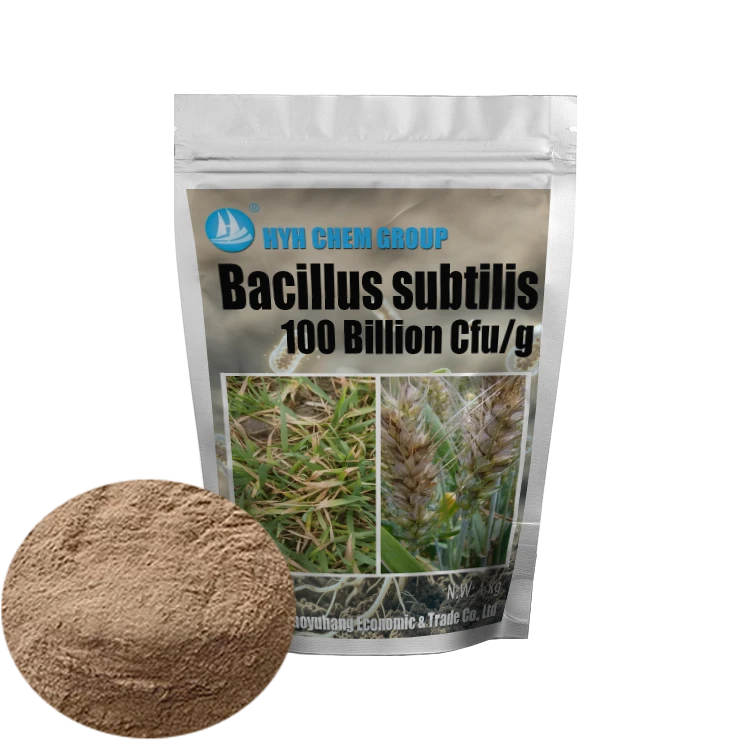

Bacillus subtilis doesn't rely on any single mechanism - rather, it works simultaneously through multiple pathways: competition, antimicrobial activity, and induced resistance.
Key Attributes
Industry-specific attributes
|
CAS No. |
68038-70-0 |
|
Purity |
10/20 Billion CFU/g |
Other Attributes
|
Place of Origin |
Henan China |
|
Other Names |
Bacillus subtilis |
|
State |
Powder |
|
Application |
Fungicide with protective action |
|
Brand Name |
HYH |
|
Model Number |
TECH |
|
Product name |
Bacillus subtilis |
|
Appearance |
Powder |
|
Shelf life |
2 years properly stored |
|
Storage |
Dry place, sealed |
Disease Control: Broad-Spectrum, but Strain-Dependent
Bacillus subtilis is effective against a wide range of fungal and bacterial diseases. Its wettable powder formulations are registered for control of Panax notoginseng root rot, cotton Verticillium wilt, rice blast and sheath blight, tobacco brown spot and black shank, sugar beet leaf spot, and pepper Fusarium wilt - with extension guidance also covering bacterial wilt, powdery mildew, gray mold, and potato late blight.
One caveat: different strains differ in their disease-control capacity. For example, one strain showed 63.11% relative efficacy against cucumber powdery mildew, while another strain (WKBS-26) achieved over 90% average efficacy against the same disease. "Bacillus subtilis" is a species name - the actual performance of a given product depends on the strain it contains.
Modes of Action: More Than Just "Killing Pathogens"
Its disease-control logic runs along multiple parallel pathways:
Competitive colonization: Spores can survive and multiply on leaves or in the rhizosphere, rapidly occupying space and nutrients - leaving pathogens "nowhere to land and nothing to eat."
Secretion of antimicrobial substances: The bacterium synthesizes a range of antimicrobial secondary metabolites, including lipopeptides (such as fengycin), polyene antibiotics, and siderophores. These work by inhibiting pathogen protein synthesis and competing for iron ions, among other mechanisms.
Key Usage Limitations
Timing must be early: Apply before disease onset or at the earliest stages. Once disease breaks out across a field, efficacy drops noticeably.
Mixing requires care: Do not mix with streptomycin, and do not mix with alkaline pesticides. However, combining it with certain chemical fungicides (such as prochloraz, tricyclazole, or jinggangmycin) can actually produce a synergistic effect.
Strong stress tolerance is a product advantage: Its spore and capsule structures make it tolerant of drought and UV radiation, with a long shelf life and high formulability. This is also why it's easier to use than many other live-microbe products.
Packaging And Delivery
|
Selling Units |
Single item |
|
Single package size |
10X10X10 cm |
|
Single gross weight |
1.500 kg |
Lead Time
|
Quantity (kilograms) |
1 - 100 |
> 100 |
|
Lead time (days) |
7 |
To be negotiated |
Customization
|
Customized labels |
Custom packaging |
|
Min. order: 1000 kilogram |
Min. order: 1000 kilogram |
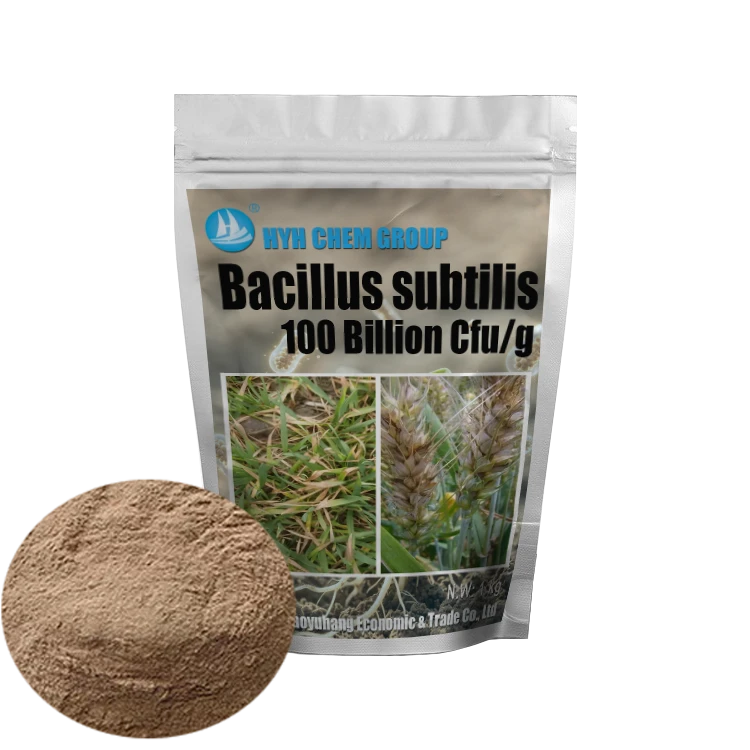



Packing & Delivery

Our Service

FAQ
Hot Tags: agricultural bacillus subtilis probiotic powder 10/20 billion cfu/g biofertilizer for soil health, root growth & crop protection cas 68038-70-0, China agricultural bacillus subtilis probiotic powder 10/20 billion cfu/g biofertilizer for soil health, root growth & crop protection cas 68038-70-0 manufacturers, suppliers, factory, fungicide for annual plants, fungicide for golf courses, fungicide for root rot, fungicide for temperate plants, fungicide sales, fungicide website


